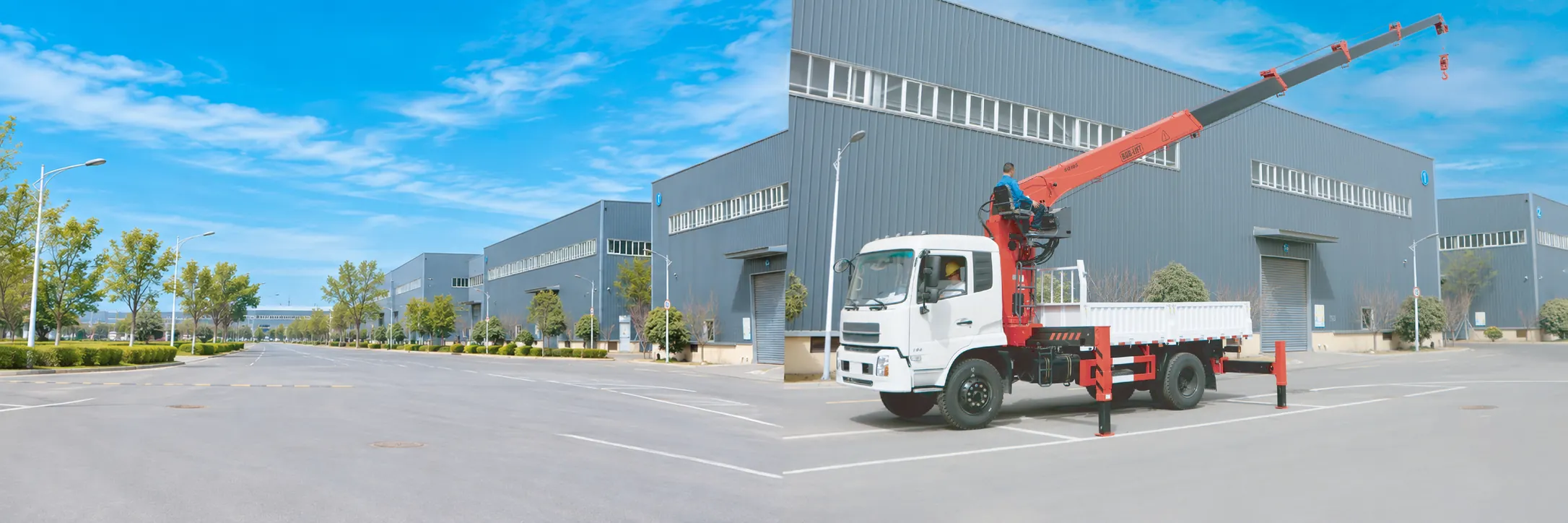

The difference between a knuckle boom and a telescopic boom truck crane is how the boom moves. A knuckle boom crane folds at a joint, like an arm at the elbow, and pushes its load out on hydraulic extensions. A telescopic boom crane, also called a straight boom crane, slides its sections out in one straight line and lifts on a wire rope. That one difference decides how far each crane reaches, how it packs onto the truck, what it asks of the truck’s hydraulics and where it works best.
Most comparisons stop at general pros and cons. This one compares real machines: five pairs of current BOB-LIFT cranes, one knuckle and one telescopic in each capacity class from 3.2 t to 12 t, using the figures and load charts from our technical department’s drawings. Achord Chan, Product Operations Director at BOB-LIFT, checked every number against the original drawings.
Key takeaways
- In the same capacity class, our telescopic cranes reach further: 10.5 to 16.2 m against 9.4 to 14.7 m for the knuckle boom models.
- At the same working radius, rated capacity is close. The 8 t knuckle crane lifts 1,820 kg at 8.5 m, against 1,500 kg for the 8 t telescopic crane at that radius or more.
- From 8 t up, the knuckle cranes need less oil flow and less power: 40 L/min and 25 kW against 55 L/min and 30 kW at 8 t.
- A knuckle crane folds into a compact block behind the cab. A telescopic boom lies along the truck.
- Choose a knuckle boom for compact, precise placing over obstacles. Choose a telescopic boom for long reach and high lifts with a winch.
What is the difference between a knuckle boom and a telescopic boom crane?
A knuckle boom crane, also called an articulating or folding boom crane, has an inner boom and an outer boom joined by a hinge, the knuckle. Hydraulic cylinders raise the inner boom and swing the outer boom, and extension sections slide out of the outer boom. Because the boom bends, the operator can reach up and over a wall, then down to the ground on the other side.
A telescopic boom crane, also called a straight boom or stiff boom crane, has one boom made of sections that slide out of each other. A cylinder sets the boom angle, and the hook hangs on a wire rope from a winch, so it can be raised and lowered without moving the boom. In the Philippines and the United States, a truck with this kind of crane is often called a boom truck. It is sometimes also called a telehandler, but that is a different machine: a telehandler is a self-propelled telescopic handler with forks, not a crane mounted on a truck.


Knuckle boom vs telescopic boom: real specs side by side
Each row pairs a knuckle crane with a telescopic crane of the same rated capacity. All figures are from the dimension drawings. Maximum reach is the horizontal distance from the slewing centre to the hook with the boom fully out.
| Class | Model | Boom | Lifting moment | Self weight | Max. reach | Oil flow / pressure | Recommended power | Rotation |
|---|---|---|---|---|---|---|---|---|
| 3.2 t | SQ3.2ZA4 | Knuckle | 6.8 t·m | 1,450 kg | 9.4 m | 25 L/min, 25 MPa | 14 kW | 400° |
| SQ3.2SA4 | Telescopic | 7 t·m | 1,350 kg | 10.5 m | 25 L/min, 20 MPa | 14 kW | 360° | |
| 5 t | SQ5ZA4 | Knuckle | 10.5 t·m | 2,386 kg | 9.9 m | 35 L/min, 28 MPa | 22 kW | 400° |
| SQ5SA4 | Telescopic | 12.5 t·m | 2,400 kg | 11.8 m | 32 L/min, 21 MPa | 18 kW | 360° | |
| 8 t | SQ8ZA4 | Knuckle | 16.7 t·m | 3,050 kg | 10.5 m | 40 L/min, 28 MPa | 25 kW | 360° |
| SQ8SA4 | Telescopic | 20 t·m | 3,600 kg | 14.0 m | 55 L/min, 26 MPa | 30 kW | 360° | |
| 10 t | SQ10ZA6 | Knuckle | 21 t·m | 3,700 kg | 14.7 m | 40 L/min, 30 MPa | 30 kW | 360° |
| SQ10SA4 | Telescopic | 25 t·m | 3,800 kg | 15.5 m | 63 L/min, 26 MPa | 37 kW | 360° | |
| 12 t | SQ12ZA4 | Knuckle | 27 t·m | 4,480 kg | 10.2 m | 55 L/min, 28 MPa | 30 kW | 360° |
| SQ12SA4 | Telescopic | 33 t·m | 4,600 kg | 16.2 m | 75 L/min, 26 MPa | 45 kW | 360° |

Knuckle or telescopic: which reaches further?
The telescopic crane reaches further in every class we compared. The gap is smallest at 10 t, where the SQ10ZA6 reaches 14.7 m against 15.5 m for the SQ10SA4. It is largest at 12 t, where the SQ12ZA4 reaches 10.2 m and the SQ12SA4 16.2 m. A knuckle crane’s reach depends heavily on how many boom sections it has, so if you need a knuckle boom with long reach, compare models with more sections in the same class.
Knuckle or telescopic: which lifts more at the same radius?
Neither by much. The headline tonnage only applies close to the column, and both types lose capacity quickly as the load moves out. When we lay the knuckle crane’s load chart over the telescopic crane’s chart at the same working radius, the two stay within about a fifth of each other up to the knuckle crane’s maximum reach. The largest relative gap is 1,820 kg against 1,500 kg at 8.5 m on the 8 t pair, about 21%.
Many comparisons state that a telescopic crane simply lifts more than a knuckle crane. Within the same capacity class, our charts do not support that as a general rule: the telescopic crane often rates higher around 4.5 m, the knuckle crane often rates higher further out, and which type wins depends on the radius.
For a fair comparison, we took each capacity box on the knuckle crane’s chart and found the best telescopic rating at the same radius or further out, using any boom length on its chart. That follows the usual rule of reading a chart at the next larger radius, explained in our guide on how to read a crane load chart.
| Working radius | SQ8ZA4 knuckle | SQ8SA4 telescopic | Higher rating |
|---|---|---|---|
| 2.0 m | 8,000 kg | 8,000 kg | Equal |
| 4.5 m | 3,700 kg | 4,300 kg | Telescopic |
| 6.4 m | 2,470 kg | 2,300 kg | Knuckle |
| 8.5 m | 1,820 kg | 1,500 kg | Knuckle |
| 10.5 m | 1,420 kg | 1,300 kg | Knuckle |
At 10 t and 12 t the telescopic crane rates higher close in: 5,100 kg against 4,650 kg at 4.5 m, and 6,600 kg against 5,700 kg at 4.7 m. At 5 t the knuckle crane leads at 4.45 m, 2,350 kg against 2,200 kg. Further out, the 8 t knuckle crane rates higher at every box. The 10 t knuckle crane draws level at 8.5 m (2,280 kg against 2,270 kg) and leads beyond it: at 12.6 m the SQ10ZA6 lifts 1,480 kg against 1,300 kg for the SQ10SA4. At 12 t the knuckle crane leads at 6.45 m (3,750 kg against 3,650 kg), the telescopic crane leads at 8.2 m (2,900 kg against 2,750 kg), and the two are equal at 10.15 m. In every pair, the telescopic crane then keeps going past the knuckle crane’s last box.
| Class | Working radius | Knuckle | Telescopic |
|---|---|---|---|
| 5 t (SQ5ZA4 / SQ5SA4) | 4.45 m | 2,350 kg | 2,200 kg |
| 5 t (SQ5ZA4 / SQ5SA4) | 9.9 m | 700 kg | 750 kg |
| 10 t (SQ10ZA6 / SQ10SA4) | 4.5 m | 4,650 kg | 5,100 kg |
| 10 t (SQ10ZA6 / SQ10SA4) | 12.63 m | 1,480 kg | 1,300 kg |
| 12 t (SQ12ZA4 / SQ12SA4) | 4.7 m | 5,700 kg | 6,600 kg |
| 12 t (SQ12ZA4 / SQ12SA4) | 10.15 m | 2,100 kg | 2,100 kg |
The chart below plots every knuckle chart box against the telescopic rating at the same radius.

So do not choose a boom type for its lifting power alone. Choose it for the reach you need, then check the actual chart of the model at your real radius.
What each type asks of the truck
Weight. From 8 t up, our knuckle cranes are lighter than the telescopic crane in the same class. The gap is 550 kg at 8 t (3,050 kg against 3,600 kg) and 100 to 120 kg at 10 t and 12 t. At 5 t the two weigh about the same, and at 3.2 t the knuckle crane is 100 kg heavier. So the common claim that a knuckle crane is always the lighter choice only holds from 8 t up in our range. Lower crane weight leaves more payload for the load on the deck.
Hydraulics. The knuckle cranes work at higher pressure, 25 to 30 MPa against 20 to 26 MPa, and from 8 t up they need much less oil flow. The common claim that knuckle cranes always need less power does not hold at 5 t: the SQ5ZA4 asks for 35 L/min and 22 kW, the SQ5SA4 for 32 L/min and 18 kW, and at 3.2 t both ask for 25 L/min and 14 kW. The SQ10ZA6 needs 40 L/min and a recommended 30 kW. The SQ10SA4 needs 63 L/min and 37 kW. So from 8 t up, a knuckle crane can run on a smaller pump and power take-off (PTO).
Mounting space. The installation space on our drawings is 750 to 1,100 mm of frame for the telescopic models and 850 to 1,400 mm for the knuckle models that list it, so in the 3.2 t, 5 t and 12 t classes the knuckle crane takes more frame length behind the cab, even though it folds into a compact block. Our guide to truck mounted crane installation and chassis requirements explains how to check payload, axle loads and the PTO for either type.
How each one stows on the truck
A knuckle crane folds into a compact block behind the cab. On its drawing, the SQ8ZA4 folds to 2,460 mm long, 2,340 mm high and 1,031 mm wide, and the SQ10ZA6 to the same length and height at 1,199 mm wide. The whole deck behind it stays free for cargo.
A telescopic boom stows lying down along the truck. Fully retracted, the SQ8SA4’s hook still sits 5.0 m out from the slewing centre, and the SQ10SA4’s 5.25 m out, so the boom lies over the deck. That suits trucks that carry long loads such as pipes or steel, as long as the stowed boom does not get in the way of loading.
Straight boom vs knuckle boom: hook height and working style
The telescopic crane’s winch lets the operator raise and lower the hook on its rope while the boom stays still. That suits lifting high, such as roof sheets onto a building, and lowering loads into pits.
The knuckle crane moves the hook by moving the boom itself, which gives the operator close control when placing a load in a tight spot. The bend lets it reach over walls, fences and parked vehicles, and work under a low roof or ceiling where a straight boom would need to rise. The SQ3.2ZA4 and SQ5ZA4 also slew through 400°; the telescopic models in these classes list 360°.
Neither type is built for dragging loads or pulling sideways. Some guides present side loading as a strength of knuckle boom cranes and give dragging a load as an example. Side pulls put forces on the boom, the slewing gear and the truck frame that the load chart does not cover, so lift vertically and only pull sideways if the crane manual specifically allows it.
Which should you choose?
Start from the job, not the crane.
- Choose a knuckle boom for deliveries of building materials, pallets and blocks onto sites with walls or tight access, for work under low roofs, when you need the whole deck free, or when the truck has a smaller PTO.
- Choose a telescopic boom when you need the longest reach and hook height in a capacity class, when you lift high or lower into pits on a rope, or when the truck carries long loads that can sit under the boom.
- Either type can do general loading and unloading of the truck itself. Then compare the load charts at your usual radius and the weight and PTO each crane asks of your truck.
You can compare all our models in the knuckle boom truck mounted crane range and the telescopic boom truck mounted crane range, or browse by capacity, for example all 10 ton cranes.
Frequently asked questions
Is a knuckle boom crane better than a telescopic crane?
Neither is better in general. In our five pairs, the telescopic crane always reaches further, while the knuckle crane folds into a compact block behind the cab (though it needs more frame length to mount) and, from 8 t up, weighs less and needs less oil flow. Rated capacity at the same radius is close. The right choice depends on your reach, your site and your truck.
Can a knuckle boom crane lift as much as a telescopic crane?
Yes, within its reach. In the four pairs with load charts, both cranes share the same top rating at the shortest radius on the chart, and around 4.5 m the telescopic crane often rates higher; further out the knuckle crane can lead. At 8.5 m the 8 t knuckle SQ8ZA4 rates 1,820 kg and the 8 t telescopic SQ8SA4 1,500 kg. Beyond the knuckle crane’s maximum reach, only the telescopic crane can lift at all.
Boom truck vs knuckle boom crane: what is the difference?
A boom truck is a truck mounted crane. In the Philippines and the United States, “boom truck” usually means a truck with a telescopic boom crane, while articulating cranes are normally called knuckle boom cranes. The US safety standards follow the same split: ASME B30.22 covers articulating boom cranes and ASME B30.5 covers mobile cranes, including truck mounted telescopic cranes. Check the boom type in the specifications rather than relying on the name.
Which is easier to operate?
A telescopic crane has fewer boom movements, which some operators find easier to learn. A knuckle crane has more joints to coordinate but gives finer control over where the load goes. Either way, operators need training on the specific crane and must work within its load chart. On US construction sites, crane operator requirements are set out in 29 CFR 1926 Subpart CC.
Can I switch from one type to the other on the same truck?
Sometimes, but treat it as a new installation. The two types differ in weight, installation space, oil flow and pressure, so the truck’s payload, axle loads, subframe and PTO must be checked again for the new crane.
Tell us the loads, the reach and the truck you have through our contact page, and we will suggest a knuckle or telescopic model with its load chart, so you can compare them on your own numbers.
About the author: Achord Chan is Product Operations Director at BOB-LIFT, the Xuzhou truck mounted crane manufacturer. He maintains the product data on this site and checks it against the original dimension drawings and load charts from the BOB-LIFT technical department.